
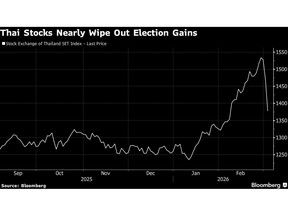
The Thai stock market resumed operations this week under a cloud of uncertainty, as the primary equity gauge extended its recent slide. This downward movement is largely attributed to the intensifying conflict in the Middle East, which has rattled global markets and pushed investors toward more cautious positions. As the trading floor opened, it became clear that the brief hiatus in activity had done little to soothe the nerves of those managing portfolios in the Southeast Asian kingdom.
A Return to Selling Pressure
The resumption of trading in Bangkok saw an immediate reaction to international developments. The stock gauge, which tracks the performance of the most significant companies in the country, struggled to find its footing. While some analysts hoped for a period of consolidation, the reality of escalating tensions abroad forced a different outcome. Market participants appear to be pricing in the potential for broader regional instability, which often leads to a risk averse environment. In such scenarios, emerging markets like Thailand frequently see an exodus of capital as investors move their funds into safer havens or more stable currencies.
I think this signals a broader trend where regional economic fundamentals are being temporarily overshadowed by geopolitical shocks. When looking at the Thai market, one must consider its reliance on external factors, such as tourism and energy costs. Any prolonged conflict in regions that produce oil tends to inflate fuel prices, which in turn places an additional burden on Thailand’s manufacturing and transport sectors.
Impact on Global Sentiment
The situation in the Middle East continues to be the dominant narrative weighing on sentiment across international bourses. For Thailand, the timing of this escalation is particularly challenging as the nation attempts to solidify its recovery. The uncertainty surrounding supply chains and the potential for increased shipping costs adds another layer of complexity to an already delicate economic landscape.
Investors are currently tasked with the difficult job to analyse how a distant conflict might translate into local losses. The slump seen as trading resumed suggests that many are choosing to err on the side of caution. It is not merely a local phenomenon; rather, it reflects a global trend where volatility has become the new norm. As long as the situation in the Middle East remains fluid, the Thai stock gauge is likely to face continued headwinds.
Looking Ahead
While the current losses are significant, market observers will be watching closely for any signs of a technical rebound. However, the centre of gravity for market movement remains firmly rooted in international news cycles. The Thai market, much like its neighbours in the region, remains sensitive to shifts in the global political climate. Until there is a clearer picture of the geopolitical trajectory in the Middle East, Thai equities may find it difficult to sustain a meaningful rally. The focus now shifts to how regional central banks and government bodies will respond to these external pressures to protect domestic growth.