
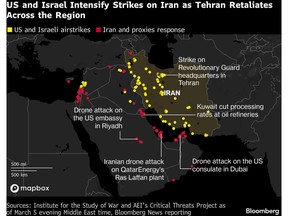
The geopolitical landscape of the Middle East shifted violently overnight as Iran initiated a broad offensive, launching a sustained barrage of missiles and drones toward several countries across the Persian Gulf. This escalation marks a significant expansion of the current hostilities, occurring as Israel continues its renewed campaign of airstrikes against the Islamic Republic. The conflict has now entered its seventh day, showing few signs of a ceasefire or diplomatic resolution. For Canadian investors and business leaders, the intensification of violence in such a critical energy corridor introduces a fresh wave of uncertainty into global markets, potentially colouring the economic outlook for the remainder of the year.
Regional Stability and Market Volatility
The overnight strikes have raised immediate concerns regarding the safety of shipping lanes and the stability of regional infrastructure. While the full extent of the damage across the Persian Gulf remains under assessment, the sheer scale of the Iranian barrage suggests a strategic shift toward a wider regional engagement. Israel, meanwhile, has maintained its offensive posture, striking targets within Iran as part of its ongoing military response. I think this signals a dangerous new phase where traditional deterrence has given way to direct, large scale confrontation.
From a business perspective, the primary concern centres on the potential for supply chain disruptions. The Persian Gulf is a vital artery for the global oil trade; any prolonged kinetic activity in the region threatens to drive up energy costs and insurance premiums for maritime transport. Canadian firms with international exposure are likely to closely monitor these developments, as the risk of a broader contagion could affect everything from commodity pricing to general market sentiment. Analysts must now analyse the resilience of energy networks in the face of such persistent aerial threats.
Political Succession and International Reaction
Amidst the smoke and fire of the regional conflict, domestic American politics have also intersected with the crisis. Former President Donald Trump has begun weighing in on matters of succession, adding another layer of complexity to an already volatile situation. While the specific nature of his comments focuses on the future of leadership, his involvement underscores how deeply the current war is intertwined with global political shifts and the defence strategies of Western allies.
The international community is now facing a difficult balancing act. As the war enters its second week, the lack of an end in sight suggests that diplomatic efforts have yet to gain significant traction. For the global economy, the duration of this conflict is just as critical as its intensity. If the seventh day of fighting is a precursor to a months long engagement, the cumulative impact on international commerce could be profound. It is a matter of honour for global leaders to seek a de-escalation, yet the centre of gravity for global risk remains firmly fixed on the events unfolding between Tehran and Tel Aviv. Security experts and economic strategists alike are forced to reconsider their projections as the situation continues to evolve rapidly.