

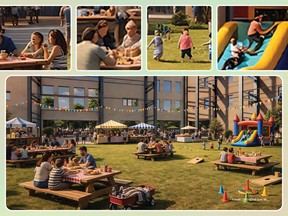
The Empress Theatre has stood as a fixture of Montreal’s Notre-Dame-de-Grâce neighbourhood for over a century. Known for its distinct Egyptian Revival architecture, the building has been a subject of community concern and speculation since it closed its doors decades ago. Recently, the borough of C.D.N.-N.D.G. released a series of renderings intended to showcase the future of the site, but the reception from the public was far from celebratory.
Aesthetic Concerns and Local Backlash
The visuals, which were meant to inspire hope for the revitalization of the theatre, instead became the centre of a heated online debate. Commenters across various social media platforms quickly pointed out what they described as “AI slop,” a term used to describe low-quality or nonsensical imagery generated by artificial intelligence. Critics highlighted inconsistencies in the architecture, strange lighting patterns, and human figures that appeared distorted or unnatural. To many residents, these details suggested a lack of care for a project that holds significant historical value for the community.
The frustration voiced by neighbours often centred on the idea that a landmark as important as the Empress deserves a dedicated human touch. When architectural renderings are perceived as being outsourced to an algorithm, it can create a sense of disconnect between the city’s planning department and the citizens they serve. In this case, the perceived reliance on automated tools felt like an insult to the theatre’s storied past and the honour of the artists who once graced its halls. Local residents noted that the blurred textures and impossible geometry found in the background of the images distracted from the actual proposal.
Balancing Innovation and Authenticity
In response to the growing criticism, city officials moved to clarify the origins of the controversial images. According to the borough, the renderings were not purely the product of a machine. The city maintains that the conceptual work was performed by in-house teams who utilized their professional expertise to design the layout and structural elements. The role of artificial intelligence was reportedly limited, with the city stating that it was used for “purely esthetic” tweaks rather than the foundational design.
This explanation has done little to soothe the most vocal critics, who argue that even minor aesthetic adjustments can undermine the integrity of a professional presentation. I think this signals a growing tension between bureaucratic efficiency and the public’s desire for human-led craftsmanship in heritage projects. While the use of AI is becoming more common in many professional fields, including architecture and urban planning, its application in the public sector remains a sensitive subject.
For the people of C.D.N.-N.D.G., the Empress Theatre is more than just a building; it is a symbol of the neighbourhood’s cultural identity. As the city moves forward with its plans, the challenge will be to ensure that the tools used to visualize the future do not overshadow the reality of the theatre’s importance. Whether these “purely esthetic” tweaks were a simple error in judgement or a sign of things to come, the conversation surrounding the Empress has clearly entered a new and digital chapter. The city must now decide if the convenience of AI is worth the potential loss of public trust.