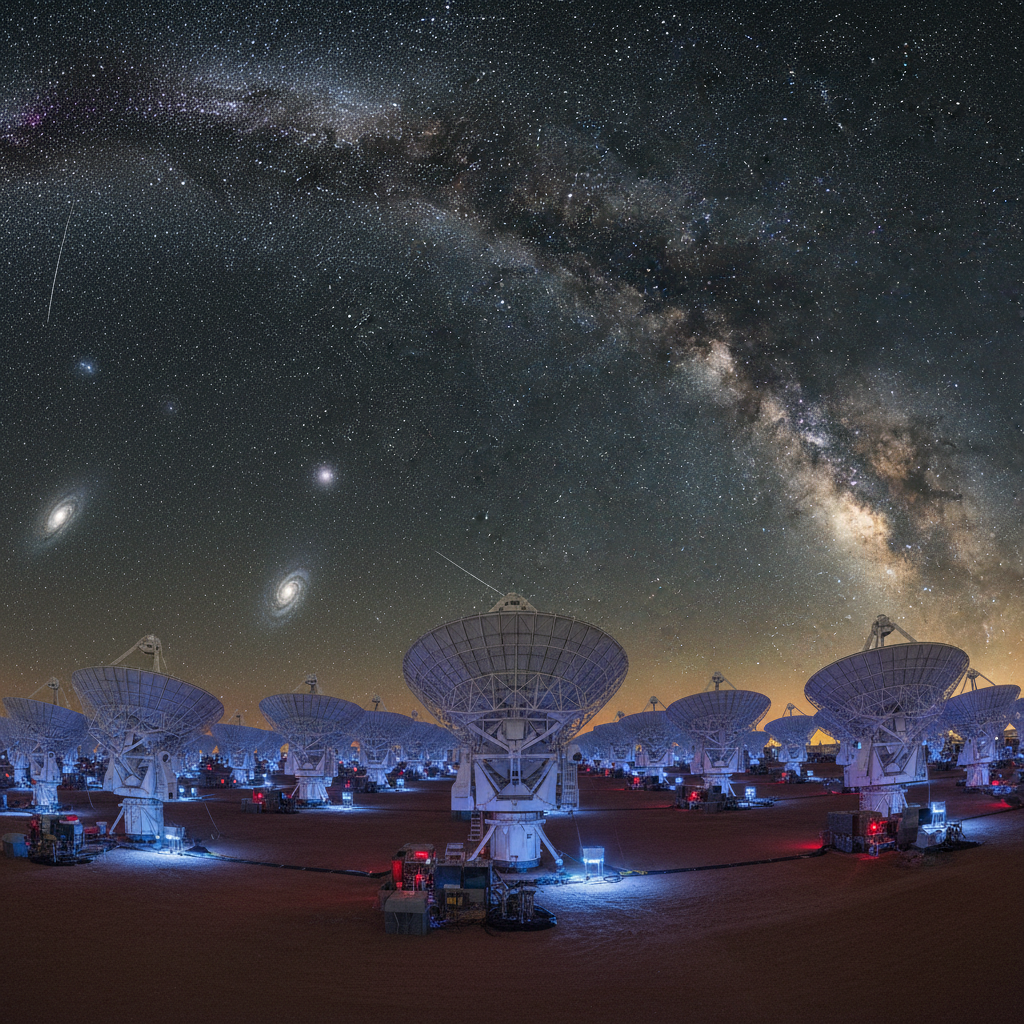
An international team of scientists including researchers from the University of Alberta and the University of Toronto has announced the first high-confidence detection of a rare ultra-high-energy cosmic-ray particle using the Giant Radio Array for Neutrino Detection (GRAND) prototype in China. The results, published May 27, detail how the experiment captured radio signals from a cosmic ray with an energy exceeding 10^19 electronvolts.
The detection marks a significant breakthrough in cosmic-ray astronomy, capturing particles with energies far beyond what human-made accelerators can produce. These ultra-high-energy cosmic rays represent some of the most extreme phenomena in the universe, yet their origins have remained largely mysterious to scientists.
Canadian Contributions Drive Detection Success
Canadian physicists played crucial roles across multiple aspects of the groundbreaking experiment. Researchers from both universities contributed to the design and calibration of the radio antenna array deployed in China, ensuring the sensitive equipment could accurately capture the fleeting radio signals produced when cosmic rays interact with Earth's atmosphere.
The Canadian team also developed key software pipelines used to reconstruct the particle's properties from the radio data, a complex computational challenge that requires extracting meaningful signals from background noise. Their work in data analysis helped confirm the detection met the high-confidence threshold required for scientific publication.
University of Alberta researchers specifically focused on antenna calibration techniques, drawing on decades of experience with radio astronomy methods. The University of Toronto team contributed expertise in signal processing algorithms that proved essential for identifying the cosmic-ray signature amid electromagnetic interference from human activities and natural atmospheric phenomena.
International Collaboration Celebrates Milestone Achievement
The GRAND collaboration expressed enthusiasm about the successful detection, with team members highlighting the years of preparation that made the breakthrough possible. The prototype array consists of 300 radio antennas spread across a 200-square-kilometre area in China's mountainous terrain, chosen for its low levels of radio frequency interference.
Project scientists noted that the detection validates theoretical predictions about radio emission patterns from cosmic-ray air showers. The successful measurement demonstrates that radio waves can provide detailed information about particle energy, arrival direction, and composition—data traditionally gathered using much more expensive optical detection methods.
Collaboration members emphasized that the achievement represents a proof-of-concept for next-generation cosmic-ray observatories. The radio detection approach offers significant advantages in terms of cost, maintenance requirements, and the ability to operate continuously regardless of weather or daylight conditions.
Radio Detection Opens New Observatory Frontier
The GRAND prototype's success demonstrates that large-scale radio detection of ultra-high-energy cosmic rays and neutrinos is now technically feasible. Unlike traditional cosmic-ray observatories that rely on optical detectors spread across vast areas, radio arrays can monitor much larger volumes of atmosphere using fewer, more cost-effective instruments.
The collaboration is using this proof-of-concept to advance plans for a much larger radio array that could map the most energetic particles in the universe. Such an expanded observatory would have the sensitivity to detect cosmic rays across a broader energy spectrum and help pinpoint their astrophysical sources.
Current cosmic-ray observatories like the Pierre Auger Observatory in Argentina and the Telescope Array in Utah have provided valuable data about ultra-high-energy particles, but their detection rates remain limited by the rarity of these events. Radio arrays offer the potential to monitor significantly larger areas of sky simultaneously, potentially increasing detection rates by orders of magnitude.
Unlocking Universe's Most Extreme Particle Accelerators
Ultra-high-energy cosmic rays with energies exceeding 10^19 electronvolts are among the rarest particles detected on Earth, arriving at rates of less than one per square kilometre per century. Scientists believe these particles originate from the most violent astrophysical processes in the universe, potentially including supermassive black holes, gamma-ray bursts, or colliding galaxies.
The ability to trace these particles back to their sources could provide unprecedented insights into cosmic acceleration mechanisms that dwarf anything achievable in terrestrial laboratories. Current theories suggest these particles may travel across billions of light-years before reaching Earth, carrying information about cosmic events that occurred in the distant universe.
The GZK cutoff—a theoretical energy limit predicted by physicists Greisen, Zatsepin, and Kuzmin—suggests that cosmic rays above certain energies should interact with cosmic microwave background radiation and lose energy during intergalactic travel. Detecting particles near or above this threshold could reveal nearby sources or challenge current understanding of cosmic-ray propagation.
Next Steps for Cosmic-Ray Astronomy
The collaboration says the prototype's success validates the radio detection approach and provides the technical foundation for scaling up to a full-sized GRAND array. Plans call for deploying thousands of radio antennas across a much larger geographic area, potentially covering hundreds of square kilometres.
Canadian researchers are expected to continue their involvement in the expanded observatory, bringing expertise in detector calibration, data analysis software, and particle reconstruction techniques. The larger array could begin operations within the next decade, offering the prospect of regular detections of ultra-high-energy cosmic rays and potentially the first observations of ultra-high-energy neutrinos from astrophysical sources.
Funding discussions for the full-scale GRAND array are ongoing, with multiple international agencies evaluating the project's scientific potential. According to the CBC News report, the successful prototype detection strengthens the case for investing in radio-based cosmic-ray astronomy as a complement to existing detection methods.
The collaboration expects that combining radio detections with data from optical and particle detector arrays will provide the most complete picture yet of ultra-high-energy cosmic rays, potentially solving longstanding questions about their origins and the extreme astrophysical processes that create them.