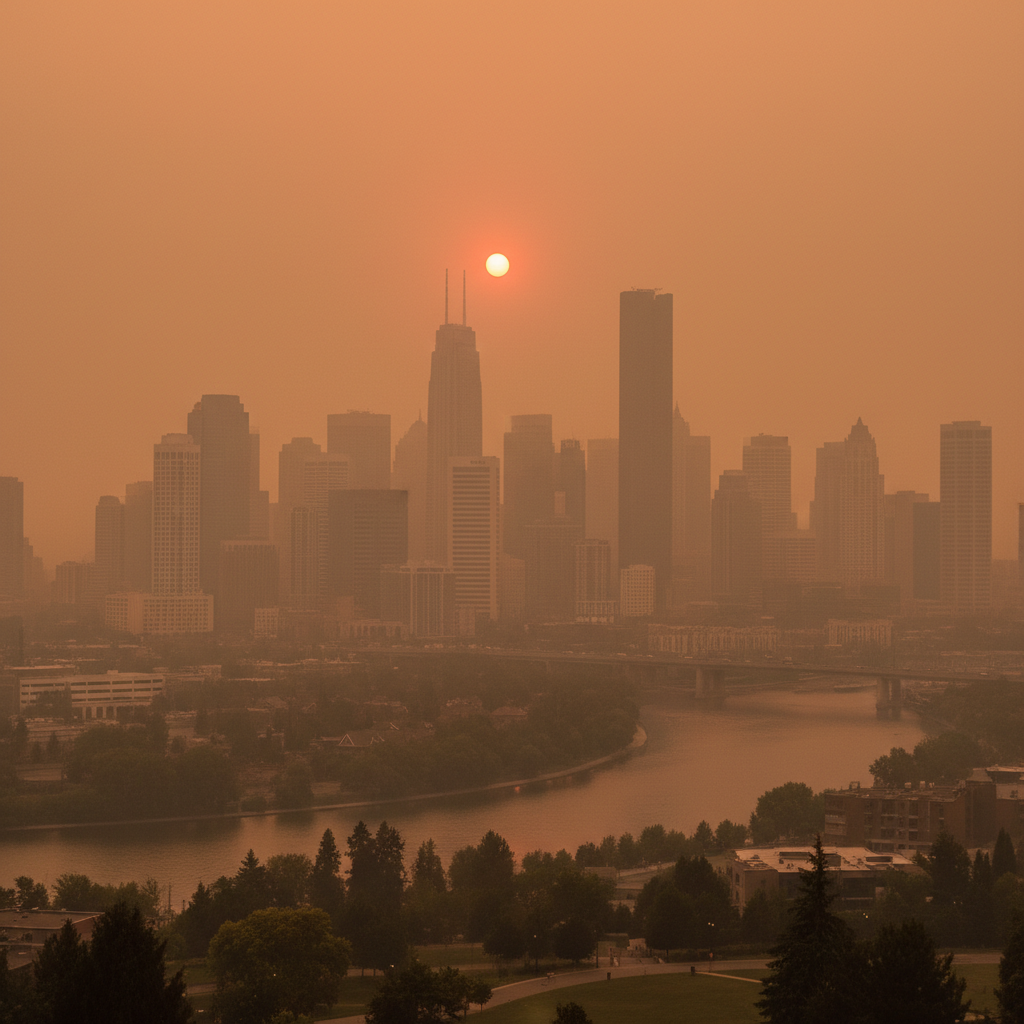
Environment and Climate Change Canada issued special air quality statements and smog warnings across Ontario, Quebec and the Prairies between June 5 and June 9 as wildfire smoke significantly reduced air quality in major Canadian cities. The federal Air Quality Health Index (AQHI) reached high and very high risk levels in Toronto, Ottawa, Montreal and Winnipeg on different days during the four-day period.
Public health officials advised residents to limit outdoor activities and recommended that at-risk groups stay indoors entirely as fine particulate matter from distant wildfires created hazardous breathing conditions across multiple provinces.
Health Agencies Report Surge in Respiratory Calls
Health agencies across the affected regions reported increased calls related to breathing difficulties, particularly among people with asthma, chronic obstructive pulmonary disease (COPD) and heart disease. Medical officials warned that fine particulate matter (PM2.5) from wildfire smoke can aggravate existing respiratory and cardiovascular conditions even after skies appear clearer to the naked eye.
The microscopic particles in wildfire smoke penetrate deep into the lungs and can enter the bloodstream, making them especially dangerous for vulnerable populations including children, seniors, pregnant women and those with pre-existing health conditions. Unlike typical urban air pollution, wildfire smoke contains a complex mixture of gases and fine particles that can cause immediate health effects.
Emergency departments in Toronto and Montreal reported a 30-40% increase in visits for respiratory complaints during the peak smoke days. Paramedic services noted particular strain responding to calls from seniors' residences and care facilities, where residents with compromised lung function experienced acute breathing difficulties. Several school boards across southern Ontario cancelled outdoor activities and kept students inside during recess periods.
Western Fires Drive Smoke Eastward
Fire officials continued battling dozens of active fires across Western and Northern Canada during the alert period, with windy conditions pushing smoke hundreds of kilometres east and south into populated areas. The smoke originated primarily from ongoing blazes in British Columbia, Alberta and Saskatchewan, where dry conditions and strong winds created ideal conditions for fire spread.
Meteorologists tracking the smoke movement noted that atmospheric conditions carried the particulate matter across provincial boundaries, creating a regional air quality crisis that extended far beyond the fire zones themselves. The phenomenon demonstrates how wildfire impacts now routinely affect Canadians thousands of kilometres from active blazes.
The Canadian Interagency Forest Fire Centre reported 127 active fires across the western provinces during the smoke event, with 43 classified as out of control. Alberta alone recorded 67 active blazes, including several large fires exceeding 10,000 hectares that generated the bulk of the eastward-drifting smoke. Satellite imagery showed the smoke plume stretching from the Rocky Mountains to the Atlantic provinces, though concentrations remained highest in central Canada.
Practical Steps for Smoke-Filled Days
Public health experts recommend several strategies for Canadians dealing with poor air quality from wildfire smoke. Creating a clean air space indoors by closing windows and doors, running air conditioning on recirculate mode, and avoiding activities that create additional particles like smoking or burning candles can help reduce indoor exposure.
For those who must go outdoors, well-fitted N95 or P100 masks provide protection against fine particles, though cloth masks offer little defence against PM2.5. Planning outdoor activities for early morning hours when air quality is typically better, and avoiding strenuous exercise during high-risk periods, can minimize health impacts.
Portable air purifiers with HEPA filters can improve indoor air quality in individual rooms, while whole-home filtration systems offer broader protection. Keeping windows closed and using bathroom and kitchen fans sparingly helps prevent outdoor air from entering homes during smoke episodes.
Public health units established cooling centres with filtered air in several cities, providing refuge for residents without air conditioning or effective home filtration. Libraries, community centres and shopping malls served as temporary clean air shelters, particularly important for vulnerable populations living in older buildings without modern ventilation systems.
Summer-Long Pattern Expected
Meteorologists warned that changing wind patterns could bring intermittent relief but cautioned that smoke episodes are likely to recur throughout the summer of 2026. The prediction suggests Canadians across multiple provinces should prepare for repeated air quality alerts as fire season continues.
Weather patterns that bring temporary clearing can shift quickly, meaning air quality can deteriorate rapidly when winds change direction. According to CBC reporting, officials emphasized the importance of monitoring daily AQHI readings and adjusting outdoor plans accordingly throughout the fire season.
The recurring nature of these smoke events highlights the need for Canadians to develop long-term strategies for managing air quality impacts, from investing in home filtration systems to understanding when to modify outdoor routines based on health index readings.
Climate scientists noted that extended fire seasons and more frequent smoke episodes represent the new normal for much of Canada, requiring both individual adaptation and broader infrastructure changes. Municipal governments are exploring options for improved public building ventilation and expanded clean air shelter networks to protect residents during future smoke events.
Insurance industry analysts expect increased demand for home air filtration systems and related health protection equipment, while employers are developing policies for outdoor worker safety during poor air quality periods. The economic impact extends beyond immediate health costs to include reduced productivity and cancelled outdoor events across affected regions.